 |
| A gift from X-Rite after filling out an online survey. Squee! |
Thursday, August 11, 2011

Gertrude Stein: The Daily Miracle

“One of the pleasant things those of us who write or paint do is to have the daily miracle. It does come.”
—Gertrude Stein
“… Stein is saying—not just that you should be on the lookout for the daily miracle (and perhaps, as I like to think, that miracle is something very basic and simple and normal from the day that suddenly elevates itself into something astonishing, or perhaps for her it was something else entirely—no way of knowing for sure, but in truth it hardly matters), but that ‘it does come.’ It does. Not it can, or it might, or even it will come. And when it comes, what it is? Is it dramatic? Is it earth shattering? No, it’s pleasant…”
Read the rest here.
Nail polish + alcohol + newspaper

I’m not really into nail polish, but this is a pretty neat idea. 1. Put on nail polish and let dry. 2. Dip fingernail in alcohol-basically any will do, vodka is suggested. 3. Press a strip of newspaper big enough to cover the whole nail on to your alcohol soaked nail. 4. Pull off slowly and be really impressed with yourself. 5. Paint top coat if desired.
Wednesday, August 10, 2011
Be Optimistic Felt Badge

“An emblem of hope in times of despair. Sew this sturdy felt backed patch onto a rucksack, jacket, or favorite cap and let it be a spark to buoy you up in the tiresome trenches of work, or on the inclement trails of adventure. Proceeds from the sale of this badge to the It Gets Better Project.”
Visit “Best Made” here, the “It Gets Better Project” here.
Image of the Day: Three-Legged Crow

Amanda Lucinda Schucker and Children Captured by Native Americans
via delanceyplace
“…many children such as Jeff Smith were captured by the Native Americans in the mid-1800s, and though heartbroken, most were treated well. Most were returned as adults, where they faced the struggle of adjusting to a way of life they had forgotten, and the second heartbreak of having lost their Native American friends and a way of life they loved:
‘Eventually, most of the captured children were sent back to their families, often against their will. Usually, a federal Indian agent, working together with a friendly Indian chief, arranged their release. But the redeemed captives found it much harder to readjust to their own people's ways than it had been to adapt to Indian society. Jeff Smith put it best: 'Everything seemed mighty tame after I got back home.’
‘As adults, many of the former child captives lived in limbo between their original and adoptive cultures. A number of common characteristics set them apart. They were often reserved and did not talk much...”
Read the rest here.
. . .
 Amanda Lucinda Schucker
My paternal great-grandmother was one of the children that were captured by Native Americans and later returned. Recollections by my grandmother and great-aunts were that she never talked much about her time living with them, that she was quite reserved and stern, and while off tending the family’s flock of sheep she would carve small stones into decorative shapes. Dozens of her stones were dispersed through several family members over the years, and I am fortunate to have some photographs and photocopies of the stones.

 |
| Just a few of the stones that she had carved over the years. These were in possession of a distant niece. |
 |
| My great-great-grandfather and Amanda’s father, Paul. How did he feel about his daughter being taken, and how she had changed years later upon her return? |
 |
| Tombstone in Valley View where she is buried with her husband and one of her sons. Elmer committed suicide at the age of 21 after years of battling epileptic seizures. |
Whisky found in Sir Ernest Shackleton’s hut recreated
 via howtobearetronaut
“Three crates of Mackinlay’s whisky and two more of brandy were recovered last year from beneath the floor of the hut, where they had been abandoned by the unsuccessful British expedition to the South Pole in 1907-09. One case was taken to New Zealand to be carefully thawed at the Canterbury Museum in Christchurch, and three of its bottles were later flown to Scotland. Now Richard Paterson, master blender at White & Mackay, which own the Mackinlay’s brand, has painstakingly recreated the original. The Glasgow-based distillery plans to produce 50,000 bottles of Shackleton's whisky at £100 a time, with 5 per cent of the sale price going to New Zealand’s Antarctic Heritage Trust, which recovered the hoard. Mr Paterson has dedicated eight weeks to blending and fine-tuning a range of malts to come up with the replica...”
Read the rest here.
Scandybars: Cross-sectional Chocolate
 via edible geography
“Scandybars, which has been scanning its way through the global chocolate bar canon since June, fully deserving of the term ‘eye-candy’…”
Visit Scandybars here. My favorites so far: Mallow Cups and Malted Milk Balls
Tuesday, August 9, 2011
Seamless Studio Pattern Power
 via colourlovers
“It truly is magical what you all are able to create using simple shapes and only five colors . . . check out the Showcase to see some examples of the wonderful patterns being created with Seamless Studio. Or check it out for yourself, download a FREE 15 Day Trial of Seamless Studio, here.”
Find out more about the application here.

Monday, August 8, 2011
The Gutter Pencil
 via Pippa’s Cabinet
Bridget Watson Payne writes, “When I was in high school I carried my pens and pencils loose in the small front zipper compartment of my jansport backpack. The pencils were for math class, but at sixteen they still carried an embarrassing aura of childhood with them, and so I made it a point to pay them as little mind as possible. As a result what I had were half a dozen pencil stubs--each maybe two inches long, eraser worn down to nothing, heavily chewed on (because, yeah, no, gnawing on your pencil isn’t infantile at all). My best friend Fern always teased me about them, referring to them as my ‘gutter pencils’ (the implication being, I guess, that they looked like I found them in the gutter)...”
Read the rest here. I used to have several very short, very chewed, yellow #2 Ticonderoga pencils in school; now I know that they had a proper name!
Yoko Ono: Hiroshima Day
 via boingboing
“Artist and peace activist Yoko Ono (78), wife of the late John Lennon, was recently honored with the 8th Hiroshima Art Prize. The award honors artists whose work has contributed to peace. To commemorate this, The Hiroshima Museum of Contemporary Art is hosting ‘The Road of Hope: Yoko Ono 2011,’ an exhibit honoring the ‘spirit of Hiroshima that yearns for permanent world peace and prosperity for all humanity.’ The show is on display through October 16, 2011. It features new works by Yoko Ono inspired by the survival of Hiroshima and Nagasaki, and by the disasters that struck Japan in March, 2011, ‘with hope for the future.’”
Read the rest here, which includes an interview with Yoko Ono; and her blog post “On Hiroshima Day August 6th 2011” here.
Alphabeasties and other Amazing Types
 via a two-winged fairy
“This typographical trip will wow design fans... Innovations arrive several to a page, encouraging readers to muse on the power of type and all that letters and words can imply or insinuate.”
Discover more in this book here. Another fun typography-inspired book by Sharon Werner is “Bugs by the Numbers,” which can be found here.

1971: Nike Swoosh

“June 1971 is the date the Nike Swoosh was launched. Designed by Carolyn Davidson for $35. The origin of the mark goes like this: Phil Knight, the co-founder of Blue Ribbon Sports (BRS) that evolved into Nike, wanted to differentiate BRS’s custom product from the ones they were importing from Onituska in Japan: ‘…so Knight turned to a graphic design student he met at Portland State University two years earlier.’ One day in 1969, the student, Carolyn Davidson, was approached by Knight and offered $2 per hour ‘to make charts and graphics’ for his business. For the next two years Davidson managed the design work on BRS. ‘Then one day Phil asked me if I wanted to work on a shoe stripe,’ Davidson recalled. The only advice she received was to ‘Make the stripe supportive of the shoe.’ Davidson came up with half a dozen options. None of the options ‘captivated anyone" so it came down to "which was the least awful...’ ”
Read the rest here.
Sunday, August 7, 2011
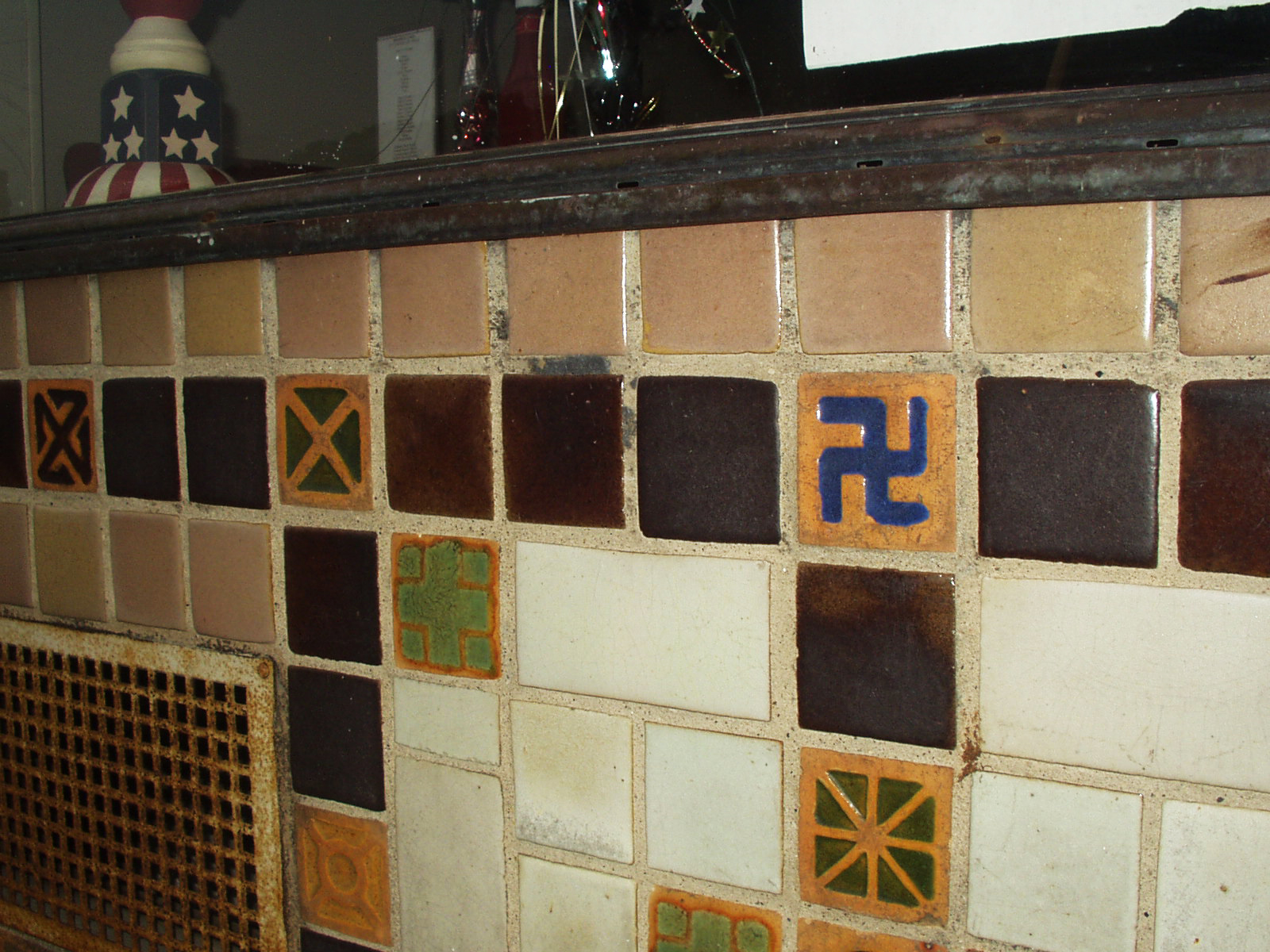
Swastikas on a Square

As a young child shopping downtown with my mother, we would often walk by this building on our way from G.C. Murphy’s to Montgomery Wards or to the lobby of the taxi business to get a ride back home on North Walnut Street.
I remember seeing the tile work, and was fascinated by all of the symbols. It wasn’t until I was a bit older that I spent much time examining them. My best guess is that building probably dates sometime around the 1920s. [As a bit of trivia, in the mid 1980s my wife and I loved meeting for lunch at The Diana Shop. We even had our tiny 4-person wedding reception there, which consisted of flavored lemon and cherry Cokes. The older waitresses there were so very friendly to us, and later on, to our newborn son.]
I knew that with the age of the building that the swastika symbol, along with all of the other ornaments, were just decoration and did not carry the meaning of Nazi Germany and WWII. Yet, there they were, and immediately upon seeing the swastika, that is all I could think of. Our culture — from comic books, TV cartoons and drama shows, movies, and history books — has burned this association together forever in our collective minds.
Years later I read a great article by Steven Heller called “Symbol of the Century” in the January / February 1992 issue of Print Magazine. I still have that issue saved in my collection of graphic design resources.
Heller recently wrote “Swastika Guilt” in Imprint, and reading it reminded me of these tiles again. Slowly, time is eroding the past, and it wouldn’t surprise me if suddenly one day this building is torn down to be replaced with a vacant lot or mini-strip mall. I made a mental note that the next time we were in town visiting our parents, that I needed to take some photos of the tiles before they were gone forever, This past weekend I had that opportunity; below are some of the images I captured.


 |
| On the way into the main entrance to the cafe, someone has even tried to scratch away the swastika; my guess is with their car keys. |
 |
| The cafe was closed late on a Saturday afternoon; the scratched swastika can be seen in the upper right. |
 |
| Despite decades of pollution and grime, the rich indigo-blue glaze is still vibrant. |
Oliver Sacks: New Cover Designs
 via howmagazine
These covers were designed in-house at Vintage by Cardon Webb and make me fall in love with the Oliver Sacks books anew.
Keep Our Secrets

“Keep Our Secrets by Jordan Crane isn’t merely a charmingly illustrated treat, it’s also an admirable piece of publishing innovation — the book is printed with thermally-activated color-changing ink that lets you discover a wealth of delightful surprises and hidden illustrations as you rub the pages and the heat from your fingers causes some ink layers to become transparent. This kind of playful, tactile interactivity in what’s still a printed, physical book is challenges our assumptions about what it means to build truly “interactive” reading experiences, showing it doesn’t necessarily have to mean device-centricity…”
Read the rest here.
Saturday, August 6, 2011
Rudolf Brazda, 98, Dies; Survived Pink Triangle
 via nytimes
“Rudolf Brazda, believed to be the last surviving man to wear the pink triangle — the emblem sewn onto the striped uniforms of the thousands of homosexuals sent to Nazi concentration camps, most of them to their deaths — died on Wednesday in Bantzenheim, in Alsace, France…”
Read the rest here.
Subscribe to:
Posts (Atom)