Showing posts with label printing. Show all posts
Showing posts with label printing. Show all posts
Monday, February 29, 2016


Saturday, January 2, 2016
Richard March Hoe Stamp
 |
| Detail of a letterbox stamp that will be placed near Printer's Park, NYC. I am very pleased with how my carving of Richard March Hoe's portrait turned out. |
Saturday, March 7, 2015
Images of the Day: Postcards

A welcome surprise discovery; hundreds of mid-century postcards from museums from around the world. The images of paintings, sculptures, and architecture appear to have been from a long-since-retired art professor. Although I liked looking at and recognizing a few of the images on the front of the postcards, I fell in love with the reverse sides. Below is a small sampling of the cards, and a some detail scans as well. Click on any of the images for an enlarged view of them.


Monday, April 7, 2014
Finding William Bullock
 |
| William Bullock |
William Bullock is sometimes referred to as the father of the web rotary printing press and modern printing. Bullock's press allowed for continuous large rolls of paper to be automatically fed through the rollers, eliminating the laborious hand-feeding system of earlier presses. The press was self-adjusting, printed on both sides, folded the paper, and a sharp serrated knife that rarely needed sharpening cut sheets with rapid precision. The press could print up to 12,000 sheets an hour; later improvements raised the speed to up to 30,000 sheets an hour. He also has the dubious distinction of being among inventors killed by their inventions.
 |
| Bullock's Rotary Press |
You'd think that after years of genealogy, geocaching, and letterboxing it would come easy to me to find a headstone with a bronze marker. Well, it helps to search for such headstones in the correct division of a cemetery. In my excited rush getting there, we initially spent a lot of time combing through Section G in a different division. Terri was a real sport, and her intuition paid off when she put all of the little bits of my quickly gathered incomplete information together. Bullock's grave site is in the very back of Lot 29, and could be easily overlooked. All in all, it was a great day filled with adventures.
 |
| Bullock's headstone |
 |
| Found at last! |
Sunday, July 31, 2011

Monday, July 25, 2011
Reynolds Stone’s Press
 via letterology
“Reynolds Stone (1909 - 1979) was a very distinguished British wood engraver, letter cutter and painter who lived in rural Dorset, England. His wife, Janet was a skilled photographer and took these two and a quarter square format photos of him and his presses in the mid-1960s. The negatives were found recently by his son-in-law and artist, Ian Beck who scanned and posted them here.”
Thursday, July 14, 2011
Graphic Novel With Thought Bubbles Visible Only Under UV
 via make
“Printed with a third ink — invisible without a UV light source — the comic book ‘SVK’ has hidden layers which are only revealed with a UV light source…”
Read a bit more about it here. I haven’t seen this graphic novel, but I do like this interesting use of printing and viewing technology.
Images from Old Books
via Brain Pickings
The site ‘From Old Books’ features over 3,100 high-resolution free images scanned from more than 180 different old or rare books, with extracts, by Liam Quin.
Visit the site here.
 |
| Detail of the title page from De Studio Literarum (1536) |
Visit the site here.
Wednesday, July 6, 2011
Old English type body sizes

“Prior to 1737, little standardisation existed in the sizes of printing types and typefounders cast types to their own sizes and dimensions. In this year, the Parisian typefounder Pierre Simon Fournier introduced a new system that he derived from dividing two inches of the pre-metric French foot into one hundred and forty-four equal parts. Fournier gave the resulting unit a name – ‘points’ – and they measured 0.137 of the English inch, which is close to the present point system…”
Read the rest here. I love that the term Nonpareil is equivalent to 6 points.
Friday, May 20, 2011
First Solar-Powered Engine

via retronaut
‘Eventually industry will no longer find in Europe the resources to satisfy its prodigious expansion. Coal will undoubtedly be used up. What will industry do then?’
— Augustin Bernard Mouchot (1825-1912), French inventor of the earliest solar-powered engine, converting solar energy into mechanical steam power
I love that the industry used in the image is a letterpress, which looks very much like the one we have at work.
Sunday, May 15, 2011
On Interrobang, Pilcrow, Capitulum, and Wayzgoose
Some small random bits . . .
 via Shady Characters The secret life of punctuation
 via worldwidewords

via Shady Characters The secret life of punctuationRead an addendum to the Interrobang, here.
via H&FJ
“ . . . In any case, Pilcrow & Capitulum would make a fine name for a pub, and a grand place to host a typographers’ wayzgoose.”
Read the entire post here.
 via worldwidewords
“The end of summer came early in old-time printing shops. By the third week in August candles were needed to light the final hours of the long working day. To mark this shift to winter working, it was usual for the master printer to give his journeymen a feast around St Bartholomew’s Day (24 August). This was the wayzgoose or way-goose…” Read more about this feast here and here.
 |
| Wayzgoose for Coventry printers at Stonebridge, c. 1907. |
Wednesday, May 11, 2011


Monday, May 9, 2011
DIY Platen Press
via letterology
 “Built with steel, oak, bamboo, cork, rope, ink, a small barrel and a great deal of ingenuity by Oakland artist and craftsman Shawn HibmaCronan. Commissioned by Compass Books, The Press will sit in their bookstore at Terminal 2 in the San Francisco Airport until 2021.”
Read more about it here, and here.
Friday, April 8, 2011
4CP | Four Color Process adventures deep inside the comic book
 via letterology
[From the 4CP blog] “. . . Lately, I've been trying to master the relationship between dot patterns and the finite color value options of vintage four-color process. Typically there were only three basic values for cyan, magenta, and yellow: 100%, 50%, and 25%, which were combined to create the optical illusion of 45-65 colors. (70% was also used sometimes.) These values account for the way a constituent color may appear as large or small dots or as what looks like a solid color with dots knocked out of it.
When you blow up process printing, you eliminate nearly all of the intended colors. There is no illusion of anything anymore, and no human intention behind what you’re seeing. It’s just the rudimentary building blocks of an inexpensive mechanical printing process, thrown into accidental relationships at the microscopic level.”
Discover more images here.
Monday, February 21, 2011
Producing a book, the analog way
via boingboing
A nostalgic look at what a it took to produce a book in the era before digital typesetting and printing.
A nostalgic look at what a it took to produce a book in the era before digital typesetting and printing.
Sunday, February 20, 2011
Ghosting: Mechanical Ghosts

via printersting
“A printing ghost is an unwanted image resulting from the printing system itself. There are basically two kinds: mechanical and chemical. Mechanical ghosts are usually visible as soon as the press sheet lands in the delivery section of the press. There are three types of mechanical ghosts: starvation, blanket, and plate.”
Read the rest of the post here. Part Two on Chemical Ghosts can be found here.
Thursday, January 27, 2011
Xavier Antin’s Just in Time, or A Short History of Production
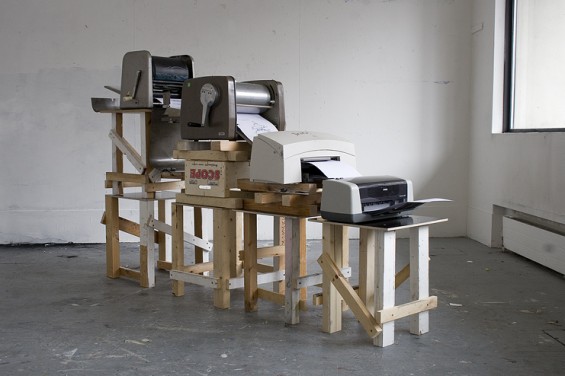 via printeresting
I’m pretty sure that this was one of the last posts in my previous blog, but I wanted to include it in the new version as well.
“Like a waterfall of printing technologies, Xavier Antin’s Just in Time, or a Short History of Production is an installation that was used to produce a book about production. Each of the four printers is from a different era and each is set to print one of the CMYK colors. The stencil duplicator does magenta, the spirit duplicator does cyan, the laser printer does black, and the inkjet does yellow. The resulting book is like a misprinted dream (or nightmare depending on how compulsive you are about registration).”
Find out more about it here.
Monday, January 24, 2011
Gutenberg and Wine

“In today’s excerpt—for Johannes Gutenberg, it was the ubiquity of winemakers nearby that helped lead to the invention of the printing press around 1440 CE . . . Sometime around the year 1440, a young Rhineland entrepreneur began tinkering with the design of the wine press. He was fresh from a disastrous business venture manufacturing small mirrors with supposedly magical healing powers, which he intended to sell to religious pilgrims. (The scheme got derailed, in part by bubonic plague, which dramatically curtailed the number of pilgrims.) The failure of the trinket business proved fortuitous, however, as it sent the entrepreneur down a much more ambitious path. He had immersed himself in the technology of Rhineland vintners, but Johannes Gutenberg was not interested in wine. He was interested in words.”
Read the entire post here.
Subscribe to:
Posts (Atom)