Showing posts with label oliver sacks. Show all posts

Sunday, August 7, 2011

Oliver Sacks: New Cover Designs


via howmagazine
These covers were designed in-house at Vintage by Cardon Webb and make me fall in love with the Oliver Sacks books anew.


Thursday, July 28, 2011

Sea of Cephalopods Octopus Necktie


via thrilllist
“A writhing sea of cephalopods creates a striking pattern on this unique necktie…”
Visit the Thrill List site here. Makes me smile...

Friday, July 15, 2011

The Color of: Oliver Sacks

via notcot
“Fung Kwok Pan has developed this slick little piece of code that allows you to enter a search query, then grabs 80 Flickr photos related to your query, then makes a composite of the photos, showing you the color of whatever you entered. It’s pretty neat to watch this thing work.”
Try it yourself here.

Friday, March 18, 2011

Six Degrees of Moby and Oliver Sacks


via wired

“On his upcoming effort Destroyed, Moby constructs synthetic symphonies out of sounds coaxed from broken-down gear during dead-of-night sessions in hotel rooms. It’s an insomniac artist’s way of making sense of the world during a time when the music industry, and everything else, seems to be falling into chaos. . . .

Wired.com: You serve on the board of directors of the Institute for Music and Neurologic Function, which works with Musicophilia: Tales of Music and the Brain author, neurologist Oliver Sacks. What would Sacks think if he heard Destroyed?

Moby: Oliver is an interesting guy, who I hold in the highest regard. But he can be a little cranky. He mainly likes classical music, so my honest answer is I think it depends on if you caught him on a good or bad day or time. If you caught him at a time where he was really relaxed and open-minded, he might take the time to listen to Destroyed’s classical and melodic influences. But I have a feeling Concetta Tomaino, the IMNF’s executive director, might be favorably disposed to it. . . .”

Read the entire article here.

Tuesday, March 15, 2011

Christopher Payne’s Asylum


via utne reader

“The state mental hospitals of the 19th and early 20th centuries—originally known as ‘lunatic asylums’—often operated within massive, majestic buildings, most of which are now abandoned or operating at a fraction of their former capacity. Christopher Payne spent several years meticulously photographing 70 of these architectural marvels, and his haunting images are collected in the beautiful new book Asylum: Inside the Closed World of State Mental Hospitals, just out on MIT Press. Neurologist-writer Oliver Sacks, who worked for 25 years at Bronx State Hospital (now Bronx Psychiatric Center), pens the book’s introduction, a lively tour through the history of these asylums’ philosophies, inner workings, and patient populations as they shifted over the years.

Read the rest here. Visit Christopher Payne’s site here to see a slideshow of images, MIT Press page here.


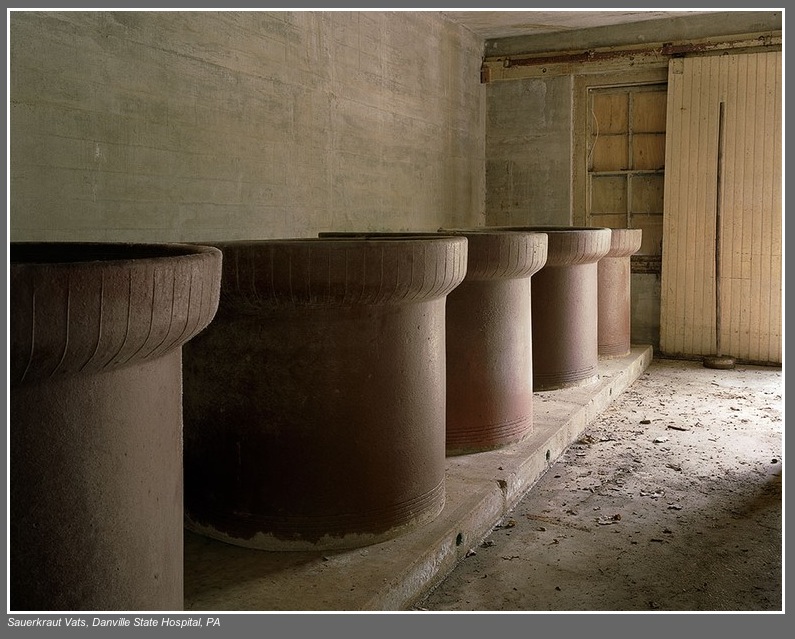
Sauerkraut Vats, Danville State Hospital, PA  As a child, I remember passing the Selinsgrove State Colony for Epileptics— a rambling state hospital on the way to visit my grandmothers. A few of the residents at that facility would stand or sit on benches by the road and wave to the passing cars traveling by on Route 522 . In later years I discovered that the daughter of one of my maternal grandmother’s sisters was a resident at one of Pennsylvania’s hospitals caring for the mentally retarded.

Wednesday, March 2, 2011

Oliver Sacks: Prosopagnosia

via world science festival
The Story of the Living, Breathing Mirror
Living with the perceptual disorder known as prosopagnosia—the inability to recognize even the faces of people you know—can be difficult. But it can also be awkwardly funny, as the legendary author and neurologist Oliver Sacks recounts from his life experiences of living face blind.


Can I Catch Face Blindness?


Coping with Face Blindness


More on Oliver Sacks’ most recent book, The Mind’s Eye, can be found here. Watch short videos featuring Chuck Close here. I remember first seeing a painting by Close at the Carnegie Museum of Art in the early ’80s. It was fascinating seeing a large painting of his from across a massive room, and being constantly amazed as I walked up to within inches of it.