Sunday, July 24, 2011

Suffragette Banners

via mary evens picture library
“The Women’s Library, part of London Metropolitan University, hold the most extensive collection of women’s history in the UK. The latest selection includes a large number of designs for suffrage banners by renowned stained-glass and poster artist Mary Lowndes. Deeply committed to the suffragette cause, in 1907 Lowndes formed the Artists’ Suffrage League which went on to create much of the promotional material for the National Union of Women’s Suffrage Societies. As chair, Lowndes contributed many designs for posters, banners and cards. Her watercolour banner sketches are notable for their use of luminous colour revealing the influence of Lowndes’s training in stained-glass. We also have images of a number of finished, sewn banners based on Lowndes’s designs.”
Please click here to view these images.

Saturday, July 23, 2011

Caren Alpert’s Microscopic Photography


Life Saver, 17X Magnification
via a friend
Read Caren Alpert’s artistic statement here, and visit her gallery here.

Chicago Brewery Goes for Zero Waste


via utne reader
“A growing number of beer makers are incorporating green practices in their brewing operations, but a couple of brothers setting up a brewery in Chicago are setting their sights even higher, reports the Chicago Reader: They’re aiming for a zero-waste facility. The key is that the New Chicago Brewing Company is not a freestanding operation but part of The Plant, a former meatpacking facility that is being renovated to house a bunch of symbiotic businesses under one roof. One makes pickles, one makes kombucha tea, and one is an aquaponics operation that will produce tilapia, greens, mushrooms, and herbs…”
Read more here and here.

Our food varieties are dwindling. So why should you care?

via writesforfood
“…Most of us in the well-fed world give little thought to where our food comes from or how it’s grown. We steer our shopping carts down supermarket aisles without realizing that the apparent bounty is a shiny stage set held up by increasingly shaky scaffolding. We’ve been hearing for some time about the loss of flora and fauna in our rain forests. Very little, by contrast, is being said or done about the parallel erosion in the genetic diversity of the foods we eat. Food varieties extinction is happening all over the world—and it’s happening fast. In the United States an estimated 90 percent of our historic fruit and vegetable varieties have vanished. Of the 7,000 apple varieties that were grown in the 1800s, fewer than a hundred remain. In the Philippines thousands of varieties of rice once thrived; now only up to a hundred are grown there. In China 90 percent of the wheat varieties cultivated just a century ago have disappeared. Experts estimate that we have lost more than half of the world’s food varieties over the past century. As for the 8,000 known livestock breeds, 1,600 are endangered or already extinct…”
Read the rest here.

Graphic Nothing’s Mona Lisa Remix


via retronaut
“Leonardo da Vinci's The Mona Lisa reduced and remixed down into 140 exact circles of colour. Makes no sense close up. Makes every sense from the other side of the room.”
More about it here. Print from your own hi-res quality from files here. Be sure to look through the Galleries section for some interesting discoveries, like Abbey Road Remix.


Tinnitus: When The Ringing Won’t Stop, Clear Your Mind

via npr
Two recent stories on NPR, Rethinking Tinnitus: When The Ringing Won’t Stop, Clear Your Mind and Tinnitus: Why Won’t My Ears Stop Ringing?

Friday, July 22, 2011

Melted Crayon Art


via cmybacon
“Jessica Kerbawy, an artist and graphic designer from Michigan, has been making these unique works of art by lining up crayons on foam board and melting them with a heat gun.”
See more of her work here.


Dyslexie: Typeface for dyslectics

spotted via a friend
The University of Twente did research on the typeface Dyslexie. Watch a part of their conclusion here.

Bolder

via swissmiss
“Bolder is a site that helps people to trigger and discover experiences that make the world a little better, one action at a time. You can start a challenge yourself or browse through the challenge catalogue and do positive actions to earn rewards. Anyone can respond to a challenge and earn a reward. Every challenge is a unique creation started by businesses or people. Challenges pose a request for users to take action, have a little fun, and be part of something that drives positive change…”
Read the rest here, visit Bolder here.

Google Books includes new Penn State titles


via Penn State University Libraries Newswire 
“Each month new Penn State titles are added to Google Books. Sacred and legendary art, Applied motion study, Hopes and fears for art, The afterglow of European travel, The castle builders, Aliens or Americans and Memorials of prison life are a few of the books now available online...”
Read the full story on Live here. Among the books they have digitized is Instruction in photography (1905). You can find the updated listing of books here.

Thursday, July 21, 2011

Rene Siegfried’s The Serif Fairy


via green chair press
“The Serif Fairy has lost her wing, keeping her from performing magic. This book follows her through an airy, immaculately designed typographic landscape as she hunts for it. Along the way, she makes friends and has adventures as she wanders through the Garamond Forest, visits Futura Town and eventually ends her quest at Shelley Lake.”
Order your copy here.

Fibonaccis Numbers: The Man Behind The Math

via npr
“Though generations of schoolchildren have cursed arithmetic, the world was a much more inconvenient place without it. Before the advent of modern arithmetic in the 13th century, basic calculations required a physical abacus. But then came a young Italian mathematician named Leonardo da Pisa — no relation to da Vinci — who, in 1202, published a book titled Liber Abaci. That’s Latin for Book of Calculation. And though it doesn't necessarily sound like an overnight best-seller, it was a smash hit. Liber Abaci introduced practical uses for the Arabic numerals 0 through 9 to Western Europe. The book revolutionized commerce, banking, science and technology and established the basis of modern arithmetic, algebra and other disciplines…”
Read the rest, and listen to the story, here.

19th Century Trade Cards and Advertisements

via letterology
“With so few marketing options available for shopkeepers in the 19th C, the trade card was considered an essential form of advertising. Designers were just as compelled to create sharp examples of typography and printing then as they are today—much of it hand lettered and illustrated to promote their skills. American cards were intended to be more colorful than some of the European cards and they soon became quite collectable. These ornate trade cards eventually evolved into the business card as we know it today…”
See more examples here, and here at Sheaff: Ephemera listed under The Printing Trades tab.

Wooden Nautical Flags

via bestmade
“The A to Z of the high seas! These bright, bold and graphic wooden flags are as eye-catching as they are functional. Based on the International Code of Signals, each flag represents a letter in the alphabet: hang just one or the entire set, spell out a coded message, or conjure up the evocative regimen of naval life. Each flag is hand-painted in the same method as our axes, in our New York City workshop, and the entire set of 26 comes securely packed in a pine storage box.”
Visit Best Made here, or at 368 Broadway, NYC

Wednesday, July 20, 2011

Connecting the Dots

via savage chickens
This just makes me smile!

Sir Kensington’s Gourmet Spiced Scooping Ketchup

via notcot
“Some things were thought to be unachievable. Gourmet spiced ketchup may now be crossed off such lists…”
Be sure to go to the notcot site here to read about the beginning of their introduction to Sir Kensington’s, and visit the playful Sir Kensington’s site itself here.

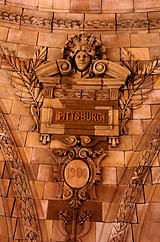
How Pittsburgh lost its ‘H’ and then got it back

H-less Pittsburg appears
under the Penn Station
rotunda Downtown.

via nor and the post gazette
“Richardson Clover had a problem, and a pretty good idea how to fix it. As assistant hydrographer in the U.S. Navy’s Bureau of Navigation in 1889, Lt. Clover was in charge of producing its maps. He’d noticed that many place names were spelled several different ways, especially in Alaska, where there were 20 indigenous languages. He suggested to Thomas C. Mendenhall, superintendent of the U.S. Coast and Geodetic Survey, that the two offices work together on standardizing place names on government charts and other official publications. Thus was born, in 1890, the U.S. Board on Geographic Names. One of its first acts, on June 2, 1891, was to take away Pittsburgh’s “H.” On Dec. 23, President Benjamin Harrison made it official. Merry Christmas, Pittsburg! Nothing personal, mind you. The board ruled that all cities and towns with name endings pronounced ‘berg’ should be spelled ‘burg.’... ”
Read the rest here.

Inside Out: A Global Arts Project

via photojojo
“The Banksy of the photo world wants you to be in his next project! 2011′s TED Prize winner JR is known for combating social inequalities with photography. He’s plastered massive 20 foot tall portraits from Paris to Brazil, Nairobi, and Cambodia. Inside Out is a photo project that asks anyone to upload their portrait with their personal story. After uploading, your photo’s then mailed to you as a poster that you can post in public. The goal? To give individuals a voice and unveil the untold stories of people around the world. Awareness and mutual respect are the aim!”
Visit the Photojojo site here, and the Inside Out site here.

Karakuri, Japan’s Ancient Robots

via make
“Japan has always been on the forefront of cutting edge robotics. Its roots can be traced back 200-300 years during the Edo period when skilled craftsmen created automata (self-operating machines). Using nothing more than pulleys and weights they were able to make the Karakuri (Japanese automata) perform amazing tasks. Today Hideki Higashino is one of the few remaining craftsmen who is determined to keep the history and tradition of Japanese Karakuri alive…”
Watch the video here.

Pantone Metal Storage Boxes

via creativepro
“Each 4"×12"×9" box costs $19.99. In addition to Macaw Green 377 to the right, there’s Pastel Lavender 672, Royal Purple 268, Ruby Red 186, Mimosa 14-0848, Turquoise 15-5519, Vitamin C 165, Cool Gray 10, Surf 286, and Honeysuckle 18-2120.”
See more about them here.