Sunday, August 14, 2011

Business Cards of the Day

South Side Tattoo and Body Piercing: Sometime, no matter how much you like a script font, you just shouldn’t use it.

Apple: Clean, classy, and a silver foil Apple logo. It just works. I have an older card from the early 80s at work that I’ll have to post again [lost when I deleted my old blog] as a comparison.

Houck & Gingrich: Simple, clean, Lewistown typesetting. At least it is all in the same font, though the letter spacing is a bit tight for all caps.

Pantone VISA®

Bodega Cats


via internets celebrities
For a smile, watch Bodega Cats by Internets Celebrities.

And while you have a few minutes to spare, also watch A Fare Slice? “In 1980, New Yorker Eric Bram noticed that for twenty years the price of a subway token had tended to match the price of a slice of pizza. Thirty years later, his hypothesis still holds true.”
Bodega Cats can be seen here; A Fare Slice? can be seen here.


Saturday, August 13, 2011

Business Cards of the Day

Espresso Yourself Cafe: Simple two color design, the typography choices are hard to read, but they do have excellent vegetarian food options!

Going Local: A lot of information packed onto this card, in fact too much information and too tiny. A better solution would have been to go to a two sided card.

Hotel State College & Company: Great ampersand, though it is a bit forced and crowded intertwining with the “S” and “C” and the gradient, well. . . it just doesn’t stand up to the test of time forcing the balance. Using thin display type for small text isn’t a good idea either, no matter how nice the font.

Rocket Science: Overall, a nice card. I like the tagline they use as well, especially since I am not mechanically inclined. Easy to read font choice too

Otto’s: Swoosh! Double swoosh! Not a fan of flush right text, and the flipping back to flush left. I miss the cat design. Perhaps just  one swoosh and a different type treatment...

Ochre Mills


via Juniata’s River Valleys By Jeffrey Adams
My in-laws loaned us a copy of the book this past weekend. Lots of interesting photos and snippets of tales. I love the name “Ochre Mills” which is near Juniata [note the typo on the old photo]. I wonder if remnants of the area still around, or if it is now silently resting under a development.
You can see more of Adams’ book here.

Fluid type font


via designboom
“Designed by Hussain Almossawi of Bahraini studio Skyrill Design, ‘fluid type’ is conceptualized as a dynamic typeface, in which each character in addition to being usable as a static letter has its own exploding animation…”
Read the rest here. I was so wishing that this included an ampersand...

Friday, August 12, 2011

30 Years of the IBM PC


via what's new now
“The IBM PC was launched 30 years ago today…”
Read the rest here.

The Old Man of the Lake


pointed out by my son
“About 7,000 to 8,000 years ago, a volcano named Mount Mazama, located in present-day Oregon, erupted, leaving behind a big crater.  Over time, water from rain and snowfall filled the hole, and Crater Lake was born.  And Crater Lake is not like most other lakes.  As seen here from above, it is a deep, undisturbed blue, having no natural rivers leading in or out of it, no fish indigenous to it (although it has since been artificially stocked), etc.  Over the course of 250 years, its water -- cold, due to the elevation (at 6,148 feet, Crater Lake is over a mile above sea level) -- is replaced via an ongoing cycle of evaporation and precipitation. But what makes Crater Lake truly unique is a solitary piece of wood, pictured right, nicknamed the Old Man of the Lake…’
Read the rest here.

The @-symbol


via shady characters
“Like the ampersand, the ‘@’ symbol is not strictly a mark of punctuation; rather, it is a logogram or grammalogue, a shorthand for the word ‘at’. Even so, it is as much a staple of modern communication as the semicolon or exclamation mark, punctuating email addresses and announcing Twitter usernames. Unlike the ampersand, though, whose journey to the top took two millennia of steady perseverance, the at symbol’s current fame is quite accidental. It can, in fact, be traced to the single stroke of a key made almost exactly four decades ago…”
Read the rest here, and a bit more here. Part 2 of the series can be found here.

Thursday, August 11, 2011

Image of the Day: Pantone Flash Drive

A gift from X-Rite after filling out an online survey.
Squee!

Gertrude Stein: The Daily Miracle


via pippa’s cabinet

“One of the pleasant things those of us who write or paint do is to have the daily miracle. It does come.”
—Gertrude Stein

“… Stein is saying—not just that you should be on the lookout for the daily miracle (and perhaps, as I like to think, that miracle is something very basic and simple and normal from the day that suddenly elevates itself into something astonishing, or perhaps for her it was something else entirely—no way of knowing for sure, but in truth it hardly matters), but that ‘it does come.’ It does. Not it can, or it might, or even it will come. And when it comes, what it is? Is it dramatic? Is it earth shattering? No, it’s pleasant…”
Read the rest here.

Nail polish + alcohol + newspaper


via cmybacon
I’m not really into nail polish, but this is a pretty neat idea. 1. Put on nail polish and let dry. 2. Dip fingernail in alcohol-basically any will do, vodka is suggested. 3. Press a strip of newspaper big enough to cover the whole nail on to your alcohol soaked nail. 4. Pull off slowly and be really impressed with yourself. 5. Paint top coat if desired.

Wednesday, August 10, 2011

Be Optimistic Felt Badge


via bestmade
“An emblem of hope in times of despair. Sew this sturdy felt backed patch onto a rucksack, jacket, or favorite cap and let it be a spark to buoy you up in the tiresome trenches of work, or on the inclement trails of adventure. Proceeds from the sale of this badge to the It Gets Better Project.”
Visit “Best Made” here, the “It Gets Better Project” here.


Image of the Day: Three-Legged Crow

My son created these origami creations of The Three-Legged Crow.

Amanda Lucinda Schucker and Children Captured by Native Americans


via delanceyplace
“…many children such as Jeff Smith were captured by the Native Americans in the mid-1800s, and though heartbroken, most were treated well. Most were returned as adults, where they faced the struggle of adjusting to a way of life they had forgotten, and the second heartbreak of having lost their Native American friends and a way of life they loved:

‘Eventually, most of the captured children were sent back to their families, often against their will. Usually, a federal Indian agent, working together with a friendly Indian chief, arranged their release. But the redeemed captives found it much harder to readjust to their own people's ways than it had been to adapt to Indian society. Jeff Smith put it best: 'Everything seemed mighty tame after I got back home.’

‘As adults, many of the former child captives lived in limbo between their original and adoptive cultures. A number of common characteristics set them apart. They were often reserved and did not talk much...”
Read the rest here.
. . . 
Amanda Lucinda Schucker
My paternal great-grandmother was one of the children that were captured by Native Americans and later returned. Recollections by my grandmother and great-aunts were that she never talked much about her time living with them, that she was quite reserved and stern, and while off tending the family’s flock of sheep she would carve small stones into decorative shapes. Dozens of her stones were dispersed through several family members over the years, and I am fortunate to have some photographs and photocopies of the stones.

Amanda Lucinda Schucker was born May 27, 1871, and married Henry Elmer Gable January 19, 1891. They had six children together. She died November 23, 1942 and is buried at the Church of God Cemetery in Valley View, PA.


Just a few of the stones that she had carved over the years.
These were in possession of a distant niece. 
My great-great-grandfather and Amanda’s father, Paul.
How did he feel about his daughter being taken, and how she had changed years later upon her return?

Tombstone in Valley View where she is buried with her husband and one of her sons. Elmer committed suicide at the age of 21 after years of battling epileptic seizures.

Whisky found in Sir Ernest Shackleton’s hut recreated


via howtobearetronaut
“Three crates of Mackinlay’s whisky and two more of brandy were recovered last year from beneath the floor of the hut, where they had been abandoned by the unsuccessful British expedition to the South Pole in 1907-09. One case was taken to New Zealand to be carefully thawed at the Canterbury Museum in Christchurch, and three of its bottles were later flown to Scotland. Now Richard Paterson, master blender at White & Mackay, which own the Mackinlay’s brand, has painstakingly recreated the original. The Glasgow-based distillery plans to produce 50,000 bottles of Shackleton's whisky at £100 a time, with 5 per cent of the sale price going to New Zealand’s Antarctic Heritage Trust, which recovered the hoard. Mr Paterson has dedicated eight weeks to blending and fine-tuning a range of malts to come up with the replica...”
Read the rest here.

Scandybars: Cross-sectional Chocolate


via edible geography
“Scandybars, which has been scanning its way through the global chocolate bar canon since June, fully deserving of the term ‘eye-candy’…”
Visit Scandybars here. My favorites so far: Mallow Cups and Malted Milk Balls

Tuesday, August 9, 2011

Seamless Studio Pattern Power


via colourlovers
“It truly is magical what you all are able to create using simple shapes and only five colors . . . check out the Showcase to see some examples of the wonderful patterns being created with Seamless Studio. Or check it out for yourself, download a FREE 15 Day Trial of Seamless Studio, here.”
Find out more about the application here.


Image of the Day: Newport

I love the this aged flooring at Espresso Yourself in Newport.

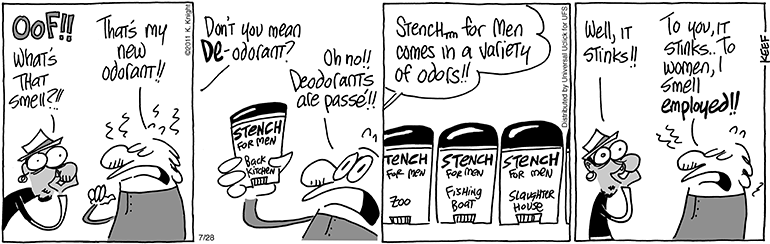
Oderants: Stench for Men


via the knight life
Love the variety of scents!