
Monday, March 7, 2011
Image of the Day: Electro • Touch

Ads Worth Spreading
 via TED
“The 10 winners of TED’s inaugural Ads Worth Spreading initiative have been announced from the stage. Selected from more than 1,000 submissions from around the world, they are some of the most creative, compelling and out-of-the-box communications of the past year. The winners are a truly diverse group — from major agencies to tiny boutiques to college students and non-profits, hailing from around the world.
Chris Anderson had this to say about the effort: “We’re seeking to reverse the trend of ads being aggressively forced on users. We want to nurture ads so good you choose to watch – and share. On TED.com, ads run after our talks, not before. As well as avoiding the annoyance of interruption, this positioning means they can run longer than the TV-standard 30-seconds. And that’s the key — in 2-3 minutes, there’s more time to tell a story, share an idea, make an authentic human connection. These winning ads, many of them long-form, powerfully demonstrate these strengths. We think they represent an exciting new way for companies to engage with the world in the internet age.”
Read the rest here, and watch the videos here.
Edinburgh Civic Survey (1949)
 via Ace Jet 170
“This huge book (280 x 360mm & 111 pages) is full of the incredible post-war maps of Edinburgh. Prepared by Patrick Abercrombie and Derek Plumstead for the Town Council, the book contains detailed data for traffic, health, education, recreation, population density and so on, beautifully depicted in a series of maps, charts and diagrams.”
More about the book can be found here. I especially love the compasses that sit at the foot of each map under the key.
Sunday, March 6, 2011
Kodak Moments
This weekend has been filled with Kodak moments. My father-in-law is working on recreating the top portion to a wooden tripod that was built before 1914, and he shared his progress with us.
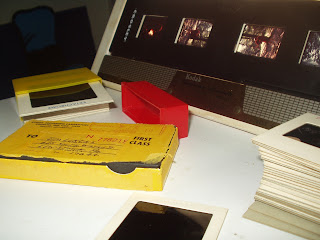
We also set-up the Crosley slide and negative scanner on their Mac as well. Above is the set-up using a Kodak Transparency Illuminator to view the slides. The slides here were processed October 27, 1965 and cost 10¢ for first class shipping.
More on Kodak’s Folmer & Schwing Division, their professional apparatus division, can be found here. See a Kodak Folmer & Schwing No 8 Cirkut Outfit Cycle Graphic wooden tripod here.
 |
| On the left, a similar tripod top found at an antique store. He is using this 1914 version as a guide for recreating a larger version. He fabricated the brass fixtures himself. |
 |
| The Folmer & Schwing tripod top -- with an ampersand stamped into the wood. |
 |
| Close-up of the ampersand. |
 |
| Demonstrating how the top goes onto the legs of the tripod. |

We also set-up the Crosley slide and negative scanner on their Mac as well. Above is the set-up using a Kodak Transparency Illuminator to view the slides. The slides here were processed October 27, 1965 and cost 10¢ for first class shipping.
More on Kodak’s Folmer & Schwing Division, their professional apparatus division, can be found here. See a Kodak Folmer & Schwing No 8 Cirkut Outfit Cycle Graphic wooden tripod here.


James Blake’s CMYK EP
 via printeresting
“This release from James Blake was apparently issued in three transparent vinyl colorways . . .”
Business Cards: Page XIV
[Top Row] White on tan can be elegant, but never works in low light situations.
 [Middle Row] The type stacking treatment almost works for The Dwelling Place -- it was a great store in Lewisburg none the less. Creative Lighting -- I was 99.9%% sure this design is from Art Nouveau design, and modified for the card. The type on the card is just a bit too crowed overall. A quick Google search for “light bulb ephemera + art nouveau” led me to this 1907 ad for AEG metallic filament lightbulbs. Thanks, Google!
[Bottom Row] pictureline — I'm not usually a big fan of all lowercase type treatments, but this works.

 [Middle Row] The type stacking treatment almost works for The Dwelling Place -- it was a great store in Lewisburg none the less. Creative Lighting -- I was 99.9%% sure this design is from Art Nouveau design, and modified for the card. The type on the card is just a bit too crowed overall. A quick Google search for “light bulb ephemera + art nouveau” led me to this 1907 ad for AEG metallic filament lightbulbs. Thanks, Google!
[Bottom Row] pictureline — I'm not usually a big fan of all lowercase type treatments, but this works.

Saturday, March 5, 2011
Rock-Paper-Scissors: You vs. the Computer
 |
| My results playing 13 rounds this morning |
“Computers mimic human reasoning by building on simple rules and statistical averages. Test your strategy against the computer in this rock-paper-scissors game illustrating basic artificial intelligence. Choose from two different modes: novice, where the computer learns to play from scratch, and veteran, where the computer pits over 200,000 rounds of previous experience against you.”

Play it here. Now I wonder how the computer would do playing Rock Paper Scissors Lizard Spock?
Contest for Pi Day
 via green chair press
“The websites Serious Eats and Instructables have held a Pi Day Pie Contest the past couple of years. (Pi Day commemorates the mathematical constant π — 3.14159… — and is held on March 14.)”
Read the rest here, and find out how to enter the 2011 Pi Day Baking Contest here. Visit the official pi day site here, and read more about the background and history here.
Ada Lovelace Day: 7 October 2011

Find out more about Ada Lovelace here, and here.
The 15 Most Important Women in Tech History
 via make
No. 2: Grace Hopper
“In addition to inventing the first computer complier in 1952, Admiral Hopper developed COBOL (Common Business-Oriented Language), was credited with popularizing the term ‘bug’ and ‘debugging’ – reportedly when she had to remove a moth from the inside of a computer, was instrumental in the creation of FLOW-MATIC language for the UNIVAC I and UNIVAC II computers and was quoted as saying ‘It is easier to ask forgiveness than it is to get permission.’”
Read more about Admiral Grace Hopper, and the other 14 women, here.
Friday, March 4, 2011
Digital Detox
 via utne reader
“The National Day of Unplugging (NDU) is observed from sundown Friday, March 4, until sundown on Saturday, March 5, NDU challenges us to turn off our smartphones, shut down our laptops, and unplug our televisions to observe a modern day of rest. Developed by Reboot, a nonprofit organization that aims to reinvent Jewish traditions, the NDU is for people of any faith or no faith. The 25-hour period is guided by Reboot’s Sabbath Manifesto, which encourages a weekly “time-out” following ten principles: 1) Avoid technology; 2) Connect with loved ones; 3) Nurture your health; 4) Get outside; 5) Avoid commerce; 6) Light candles; 7) Drink wine; 8) Eat bread; 9) Find silence; and 10) Give back.”
Read the rest here.

The Fading Sounds of Analog Technology
 Via NYTIMES by David Pogue
“As digital technology takes over, we're losing the sounds of analog technologies. And sometimes that's a real loss. A dial tone can serve a useful purpose . . . ”
Read the rest here.
Letter Heads

via the daily heller

“You’ve heard of Dead Heads (followers of the Grateful Dead), well now there are Letter Heads (grateful followers of letterhead designs). I don’t think there are as many of the latter as there are of the former, but I heard a rumor that Jerry Garcia might have collected letterheads (but then again, it is just a rumor)...”
Read the rest, and see more great examples of 1940s letterheads here. I really like how the smoke curls up through the type on this letterhead.
Finch Paper: 1930s-era Papermaking Film
 via finch
“Newsprint was Finch Paper’s stock-in-trade when this film of the papermaking process was prepared in the early 1930s. The film traces the creation of Finch Paper from New York’s Adirondack forests to our mill in Glens Falls, where logs were mechanically ground up into pulp and then made into newsprint and, ultimately, newspapers. Although our basic approach to papermaking remains remarkably similar today, the technologies and our products are far different.
Watch it here, and contrast it with making premium printing papers here.
Green’s Dictionary of Slang
 via cnn
“The publication of Green’s Dictionary of Slang—a product of 17 years of work that make it the largest slang dictionary ever published in English—is for anyone who loves words and likes to laugh.”
Read the rest of the post here.
“The three volumes of Green’s Dictionary of Slang demonstrate the sheer scope of a lifetime of research by Jonathon Green, the leading slang lexicographer of our time. A remarkable collection of this often reviled but endlessly fascinating area of the English language, it covers slang from the past five centuries right up to the present day, from all the different English-speaking countries and regions. Totaling 10.3 million words and over 53,000 entries, the collection provides the definitions of 100,000 words and over 413,000 citations.”
Priced at $450, you can order it here.
Business Cards: Page XIII

[Bottom Row] Middle card: A sample card again. The angled torn paper really helps to make this card stand out.
Subscribe to:
Posts (Atom)